
Hawaii Memory Center & Alzheimer’s Research Unit to Present EEG Biomarker Research at the 2026 London AAIC
Our team is proud to collaborate with Advanced Brain Monitoring to present new findings at the 2026 Alzheimer’s Association International Conference (AAIC) in London, United Kingdom, July 12–16, 2026.

Each year the Alzheimer’s Association International Conference brings together clinicians, neuroscientists, and researchers from around the world to share the latest science on Alzheimer’s disease and other dementias. This year, patients, caregivers, families, neurologists, and researchers connected with the Hawaii Memory Disorders Center and Alzheimer’s Research Unit are represented on the global stage through a collaborative research poster examining how the brain’s electrical activity changes in the earliest stages of cognitive decline.
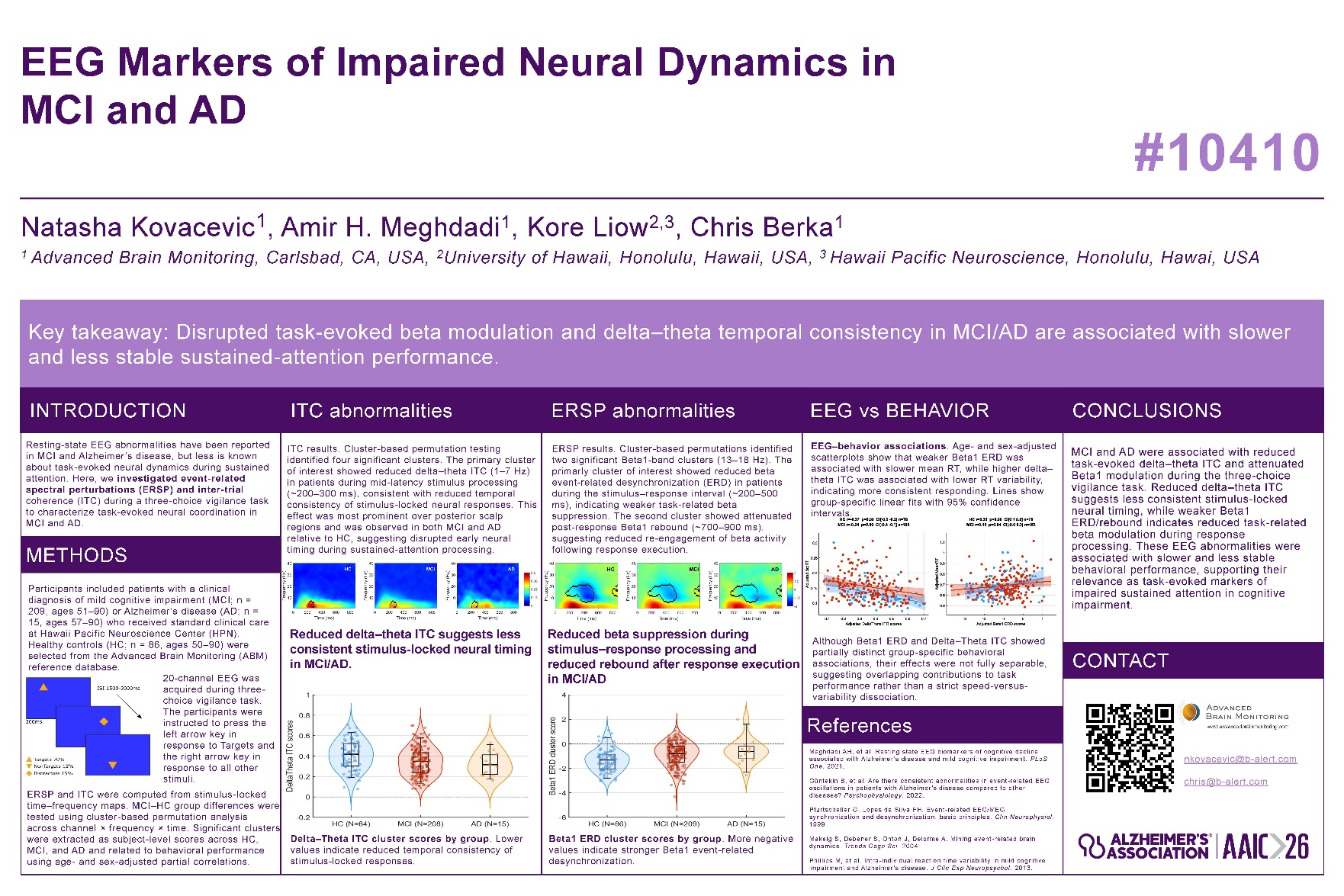
EEG Markers of Impaired Neural Dynamics in MCI and AD
Poster #10410 — AAIC 2026, London
Natasha Kovacevic1, Amir H. Meghdadi1,
Kore Liow2,3, Chris Berka1
1 Advanced Brain Monitoring, Carlsbad, CA, USA ·
2 University of Hawaii, Honolulu, HI, USA ·
3 Hawaii Pacific Neuroscience, Honolulu, HI, USA
Why This Research Matters
Electroencephalography (EEG) records the brain’s electrical activity through sensors placed on the scalp. It is non-invasive, widely available, and relatively low cost, which makes it an attractive candidate for detecting the subtle brain changes that accompany mild cognitive impairment (MCI) and Alzheimer’s disease (AD). Resting-state EEG abnormalities have already been reported in MCI and AD. Far less is understood, however, about how the brain’s activity changes while a person is actively performing a task. This study set out to fill that gap by investigating event-related spectral perturbations (ERSP) and inter-trial coherence (ITC) — two measures of how consistently and how strongly the brain responds during a sustained-attention task — in people with MCI and AD.
Who Took Part
Participants included patients evaluated at Hawaii Pacific Neuroscience Center (HPN): 209 patients with a clinical diagnosis of mild cognitive impairment (ages 51–90) and 15 patients with Alzheimer’s disease (ages 57–90), all of whom received standard clinical care. Their brain activity was compared with 86 healthy controls (ages 50–90) drawn from the Advanced Brain Monitoring (ABM) reference database.
Each participant completed a three-choice vigilance task while wearing a 20-channel EEG headset. During the task, participants pressed the left arrow key in response to Targets and the right arrow key in response to all other stimuli, a design that requires steady, sustained attention over time. Researchers then computed ERSP and ITC from stimulus-locked time–frequency maps and tested for group differences using cluster-based permutation analysis across channel, frequency, and time. Significant clusters were related to each person’s behavioral performance using age- and sex-adjusted partial correlations.
Finding 1 — Less Consistent Neural Timing (ITC)
Inter-trial coherence measures how consistently the brain’s response is timed from one trial to the next. Cluster-based testing identified four significant clusters, with the primary cluster showing reduced delta–theta ITC (1–7 Hz) in patients during mid-latency stimulus processing (roughly 200–300 ms after a stimulus appeared). This effect was most prominent over posterior (back-of-head) scalp regions and was observed in both MCI and AD relative to healthy controls. In plain terms, the brains of patients locked onto incoming information less consistently — a sign of disrupted early neural timing during sustained attention. Lower delta–theta ITC scores indicate reduced temporal consistency of stimulus-locked responses.
Finding 2 — Weaker Task-Related Beta Modulation (ERSP)
Event-related spectral perturbation measures how the strength of brain rhythms rises and falls during a task. The analysis identified two significant Beta1-band clusters (13–18 Hz). The primary cluster showed reduced beta event-related desynchronization (ERD) during the stimulus–response interval (about 200–500 ms), indicating weaker task-related beta suppression. The second cluster showed an attenuated post-response Beta1 rebound (about 700–900 ms), suggesting reduced re-engagement of beta activity after a response was made. Together these point to reduced beta suppression during stimulus–response processing and reduced rebound after response execution in MCI and AD.
Finding 3 — Linking Brain Activity to Behavior
The team then connected these EEG measures to how participants actually performed. In age- and sex-adjusted analyses, weaker Beta1 ERD was associated with slower mean reaction time, while higher delta–theta ITC was associated with lower reaction-time variability — that is, more consistent responding. Although Beta1 ERD and delta–theta ITC showed partially distinct, group-specific behavioral associations, their effects were not fully separable. This suggests overlapping contributions to task performance rather than a strict speed-versus-variability dissociation.
Conclusions
MCI and AD were associated with reduced task-evoked delta–theta ITC and attenuated Beta1 modulation during the three-choice vigilance task. Reduced delta–theta ITC suggests less consistent stimulus-locked neural timing, while weaker Beta1 ERD and rebound indicate reduced task-related beta modulation during response processing. Because these EEG abnormalities were tied to slower and less stable behavioral performance, they support their relevance as task-evoked markers of impaired sustained attention in cognitive impairment — a promising step toward accessible tools for detecting and tracking early cognitive decline.
“Our Hawaii patients, caregivers, families, neurologists & researchers are proud to collaborate with global partners to fight against neurodegenerative diseases and the efforts to improve the lives of those living with them.”
— Kore Kai Liow, MD, Neurologist & Investigator, Hawaii Memory Disorders Center & Alzheimer’s Research Unit; Clinical Professor of Medicine (Neurology), Graduate Faculty, Clinical & Translational Research, University of Hawai‘i John A. Burns School of Medicine.
References
- Meghdadi AH, et al. Resting-state EEG biomarkers of cognitive decline associated with Alzheimer’s disease and mild cognitive impairment. PLoS One. 2021.
- Güntekin B, et al. Are there consistent abnormalities in event-related EEG oscillations in patients with Alzheimer’s disease compared to other diseases? Psychophysiology. 2022.
- Pfurtscheller G, Lopes da Silva FH. Event-related EEG/MEG synchronization and desynchronization: basic principles. Clin Neurophysiol. 1999.
- Makeig S, Debener S, Onton J, Delorme A. Mining event-related brain dynamics. Trends Cogn Sci. 2004.
- Phillips M, et al. Intra-individual reaction time variability in mild cognitive impairment and Alzheimer’s disease. J Clin Exp Neuropsychol. 2013.
